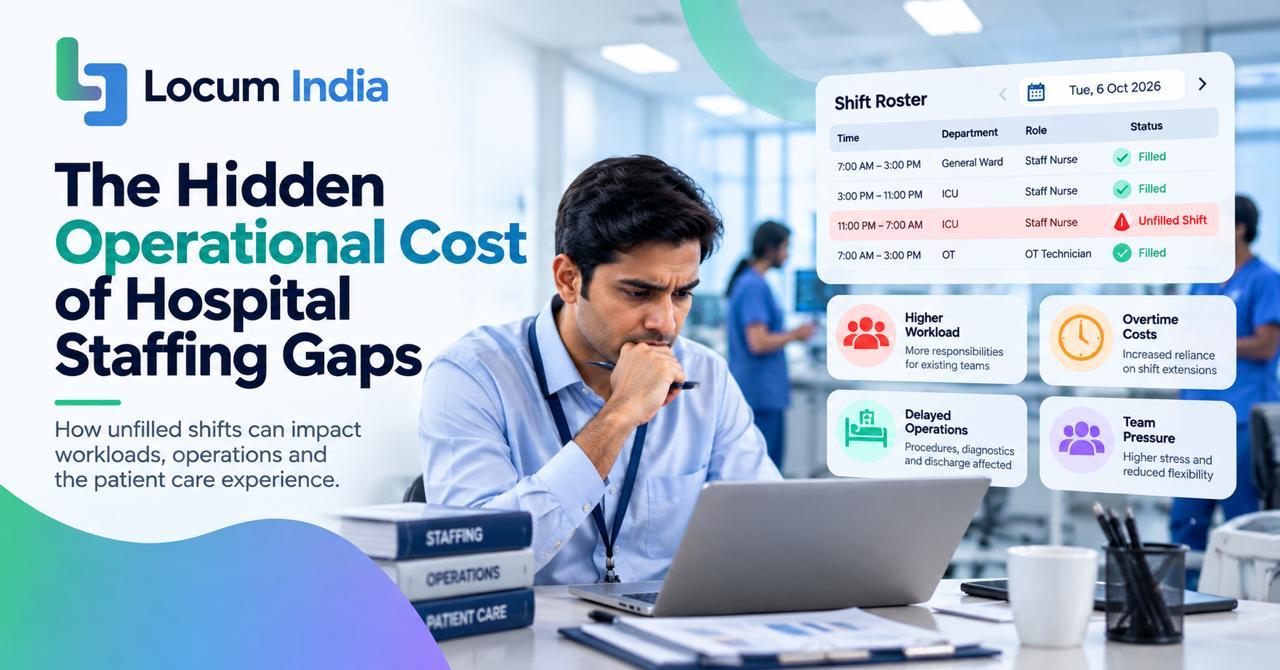
An unfilled shift may look like a single gap on a hospital roster.
Operationally, however, its impact can extend much further.
When a nurse, doctor, technician or other healthcare professional is unexpectedly unavailable, hospitals still need to maintain patient care, department coverage and day-to-day operations. The missing shift therefore has to be absorbed somewhere else in the system.
Existing team members may take additional duties. Rosters may need to be rearranged. Managers may spend time searching for replacements. Overtime may increase. In some situations, planned activities may need to be adjusted.
This is why the real cost of a staffing gap is not always visible in the vacant position itself.
It can appear across the hospital.
Hospitals operate through interconnected teams.
A shortage in one department can affect the workload and coordination of several others.
For example, when a scheduled professional becomes unavailable at short notice, the hospital may need to:
Each response may solve part of the immediate problem, but it can also create additional operational pressure.
The question therefore isn’t simply, “Is the shift covered?”
Hospitals also need to consider how the shift is being covered and what that solution is costing the wider system.
One of the most immediate effects of an unfilled shift is additional workload for the professionals who are already present.
Responsibilities may need to be redistributed among available team members until appropriate coverage is arranged.
Occasional adjustments are part of hospital operations. But when staffing gaps become frequent, repeatedly redistributing work can put sustained pressure on existing teams.
A short-term staffing problem can therefore become a broader workforce-management challenge.
Another common response to staffing shortages is asking existing professionals to work longer.
Shift extensions can be useful when a hospital needs immediate continuity, but relying on them repeatedly may increase overtime requirements and make roster management more difficult.
It can also reduce the flexibility available to managers when another unexpected gap appears later.
A more resilient staffing model needs options beyond repeatedly extending the same workforce.
There is another cost that is easy to overlook: management time.
When a staffing gap appears unexpectedly, hospital administrators, HR teams, nursing supervisors or department heads may spend significant time trying to arrange coverage.
That can involve phone calls, messages, personal networks, agencies or internal coordination.
The replacement may eventually be found, but the hours spent finding that person are also an operational cost.
A staffing system should therefore be evaluated not only by whether a replacement is found, but also by how quickly and efficiently coverage can be arranged.
Some healthcare roles are closely connected to the functioning of a particular department or service.
If the required professional is unavailable, the impact may extend beyond staffing numbers.
Depending on the role and situation, hospitals may need to reorganise schedules, redistribute responsibilities or adjust planned activities.
This is particularly relevant for roles that support time-sensitive or procedure-dependent hospital operations.
The operational value of having the right professional available at the right time can therefore be considerably greater than the cost of the individual shift.
Hospitals normally maintain some ability to adjust rosters when circumstances change.
But every staffing gap consumes part of that flexibility.
A team member moved from one area creates less capacity in another. An employee asked to extend today’s shift may be less available tomorrow. A manager using the same small pool of backup professionals repeatedly has fewer options when multiple gaps occur simultaneously.
Over time, reactive staffing can make the entire roster more fragile.
The effects of an uncovered shift do not necessarily end when that shift ends.
Changes made to solve today’s staffing problem can influence subsequent shifts, schedules and team availability.
This is why hospitals benefit from viewing short-term staffing requirements as part of workforce planning rather than as isolated emergencies.
The goal is not to eliminate every unexpected absence. That is unrealistic in any large workforce.
The goal is to build enough flexibility into the staffing system to respond without unnecessarily disrupting the rest of the hospital.
Traditional staffing models are primarily designed around permanent workforce requirements.
Hospitals, however, also experience temporary demand.
Professionals may be unavailable because of leave, illness or other commitments. Patient volumes can fluctuate. Departments can experience temporary increases in workload. Night, weekend or additional shifts may sometimes require extra coverage.
These requirements do not always justify permanent recruitment.
They require workforce flexibility.
A structured pool of verified healthcare professionals who are available for temporary or shift-based assignments can give hospitals another option when short-term requirements arise.
This does not replace the permanent workforce.
It complements it.
Many short-term staffing requirements are still managed through phone calls, messaging groups, agencies and personal networks.
These methods can work, but they often depend on repeatedly contacting people until someone is available.
Technology can make the process more structured.
A digital staffing platform can help hospitals define a requirement, identify relevant professionals, manage acceptance, maintain verification processes and track the shift through a more organised workflow.
The objective is not simply to digitise staffing.
It is to reduce the operational friction involved in responding to temporary workforce requirements.
A hospital staffing gap is rarely just an empty space on a roster.
It can influence workload, overtime, management time, departmental coordination and the flexibility of the wider workforce.
That makes short-term staffing an operational issue, not merely an HR issue.
Hospitals that develop more flexible ways to respond to temporary workforce requirements can create greater resilience when unexpected gaps occur.
Because sometimes the real cost of an unfilled shift isn’t the shift itself.
It’s everything the hospital has to change around it.
Healthcare staffing is evolving. Explore how technology, flexible work and on-demand workforce models could shape the future of healthcare staffing in India.
Traditional staffing models may not always match changing hospital needs. Explore how flexible staffing can help manage short-term demand while supporting existing teams.
 Locum
Locum