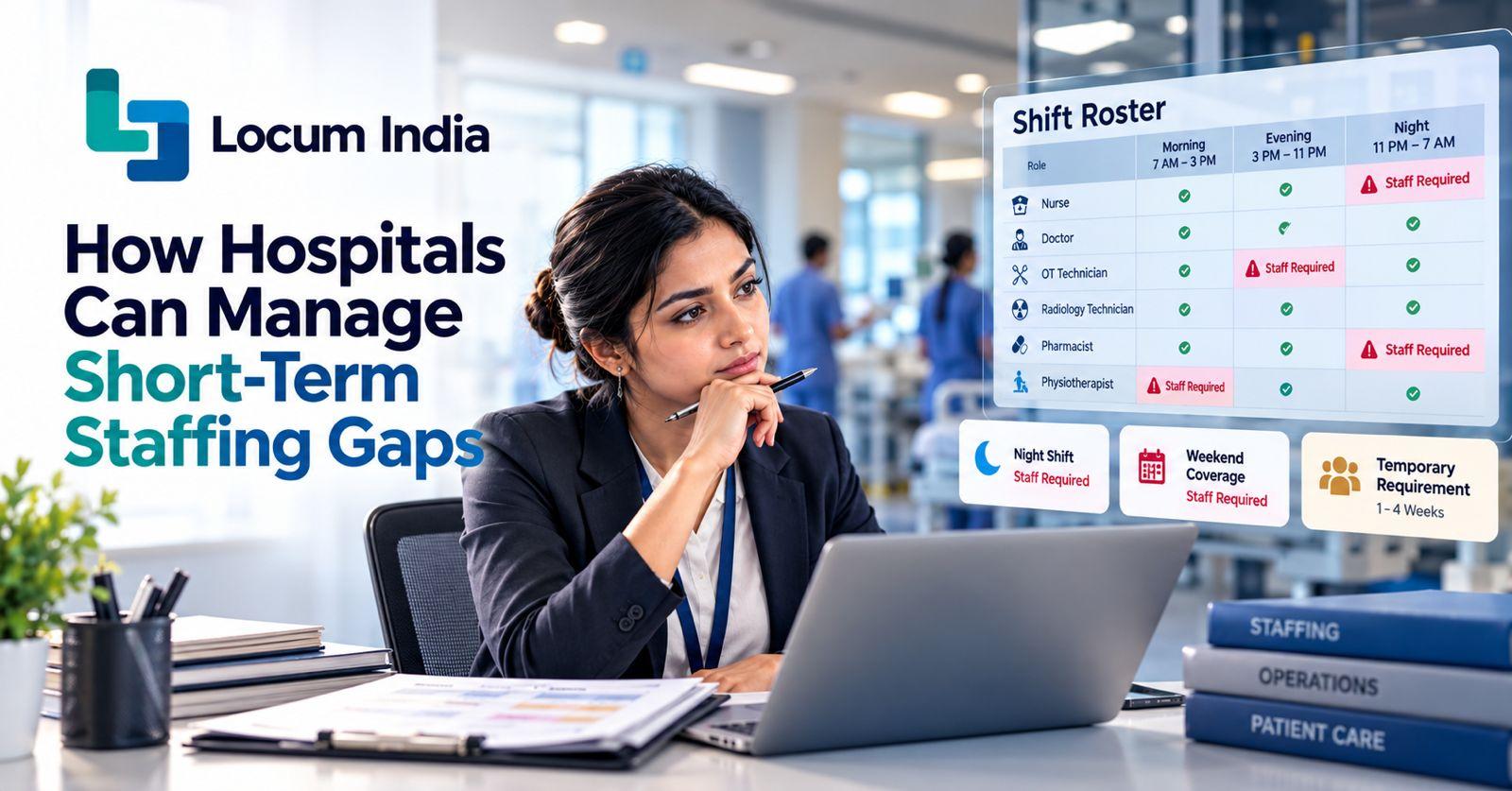
Short-term staffing gaps are a reality in hospital operations.
A nurse calls in sick before a night shift. A technician becomes unavailable unexpectedly. Patient volumes rise during a busy period. A temporary vacancy remains open while recruitment is still underway.
Individually, these situations may appear manageable.
But when the right professional is not available for the right shift, even a temporary gap can place additional pressure on existing teams and hospital operations.
The challenge for hospitals is therefore not only maintaining overall manpower numbers.
It is ensuring that appropriately qualified professionals are available when and where they are actually required.
Hospital workforce requirements are dynamic.
Even when a facility has an approved manpower plan and established duty roster, actual staffing requirements can change from day to day.
Common reasons for short-term staffing gaps include:
These situations do not always require another permanent employee.
Sometimes, the hospital simply needs appropriate professional coverage for a particular shift, day or short period.
A staffing gap rarely affects only one person or one department.
When someone becomes unavailable, hospitals often have to redistribute the workload among existing team members.
A nurse may need to cover additional responsibilities.
A technician may be asked to extend a shift.
A supervisor may spend significant time calling available staff members.
Operations or HR teams may start contacting personal networks, agencies or WhatsApp groups.
The immediate requirement may eventually be filled, but the process can still consume valuable time and create additional operational pressure.
Traditional recruitment is designed primarily for permanent vacancies.
Short-term staffing requirements operate differently.
If a hospital needs a professional for tonight’s shift, a recruitment process that takes days or weeks does not solve the immediate problem.
The requirement is usually much more specific:
Right Professional + Right Qualification + Right Shift + Right Time
This is why temporary staffing needs require a different operational approach.
Before looking for additional manpower, hospitals should first understand exactly what needs to be covered.
Not every shortage requires the same response.
A useful starting point is to define:
The clearer the requirement, the easier it becomes to identify an appropriate professional.
A vague request for “one nurse urgently required” provides far less useful information than a clearly defined shift requirement.
The first response to a staffing gap should not automatically be external hiring.
Hospitals should first evaluate whether the requirement can be managed safely within the existing workforce.
This may include checking:
For smaller or occasional gaps, internal roster adjustments may sometimes be sufficient.
However, repeatedly solving shortages through the same internal team can create another problem.
Overtime and shift extensions can be useful when used appropriately.
But they should not become the automatic answer to every staffing shortage.
Repeatedly asking existing professionals to extend shifts may contribute to fatigue and reduce the resilience of the workforce.
Healthcare work already requires sustained attention and responsibility.
Hospitals therefore need to consider not only whether someone is technically available, but whether extending that person’s duty is operationally appropriate.
A short-term staffing strategy should provide alternatives rather than depending entirely on overtime.
Some staffing requirements are temporary by nature.
A hospital may need a professional for:
In these situations, flexible shift staffing can provide another workforce option.
Instead of creating a permanent position for a temporary requirement, the facility can look for an appropriately qualified professional who is available for the required period.
This does not replace permanent staffing.
It complements the permanent workforce when temporary gaps arise.
Speed is important when filling an urgent staffing requirement.
But speed should not replace appropriate verification.
Hospitals need to know who is entering their clinical environment.
Depending on the role, relevant checks may include:
Verification should form part of the staffing process rather than becoming an afterthought once someone has already been identified.
This becomes particularly important when hospitals are working with professionals outside their regular workforce.
Many temporary staffing problems can begin with unclear expectations.
Before a professional accepts a shift, both sides should understand the basic assignment details.
These should include:
If a shift may need to be extended, the process for discussing and agreeing to that extension should also be clear.
Better information before the shift can reduce confusion after the professional arrives.
Hospitals have traditionally solved urgent staffing requirements through familiar channels.
A supervisor may call former employees.
HR may contact staffing agencies.
Team members may post the requirement in WhatsApp groups.
Someone may call another hospital employee for a reference.
These methods can sometimes work.
The challenge is that information is fragmented.
One person may know who is available.
Another may have qualification documents.
Someone else may be negotiating the shift rate.
Attendance may then be tracked separately.
This makes the process difficult to standardise, particularly when requirements become frequent or the hospital operates across multiple departments.
A more organised temporary staffing process should answer a few basic questions.
When these steps are managed through a defined workflow, temporary staffing becomes easier to track and manage.
Technology cannot eliminate staffing shortages.
But it can improve how hospitals respond to them.
A digital staffing platform can bring several previously fragmented activities into one workflow.
Instead of separately managing phone calls, messages, documents, attendance and shift records, hospitals can use a structured process to post requirements and connect with eligible professionals.
The objective is not simply to digitise a staffing agency.
It is to make temporary healthcare staffing more visible, organised and manageable.
Locum India is building a technology-enabled healthcare shift-staffing platform connecting healthcare facilities with verified healthcare professionals for temporary and shift-based requirements.
Hospitals can post requirements based on role, qualification, department, specialty, shift duration and rate.
Eligible professionals can then consider opportunities that match their professional profile and availability.
The workflow is designed around:
Post Requirement → Match → Accept → OTP Check-in → Complete Shift
Verification is built into onboarding, with identity and relevant professional credentials reviewed before professionals become eligible for shifts.
OTP-based check-in and check-out help create a structured attendance record for completed assignments.
Where a shift needs to continue beyond the original duration, the platform also supports a shift-extension workflow rather than treating the additional time as an informal arrangement.
Locum India is focused specifically on healthcare shift staffing rather than permanent-job recruitment.
Hospitals cannot predict every absence, patient surge or temporary vacancy.
But they can prepare a better process for responding when these situations occur.
That means understanding which roles are most vulnerable to temporary gaps, defining clear shift requirements, maintaining appropriate verification standards and creating access to flexible workforce capacity.
The objective should not be to replace the permanent workforce.
It should be to give hospitals another structured option when the permanent roster cannot fully meet a temporary requirement.
Because in hospital operations, a staffing gap may be temporary.
The need for appropriate patient care is not.
Healthcare staffing is evolving. Explore how technology, flexible work and on-demand workforce models could shape the future of healthcare staffing in India.
Traditional staffing models may not always match changing hospital needs. Explore how flexible staffing can help manage short-term demand while supporting existing teams.
 Locum
Locum