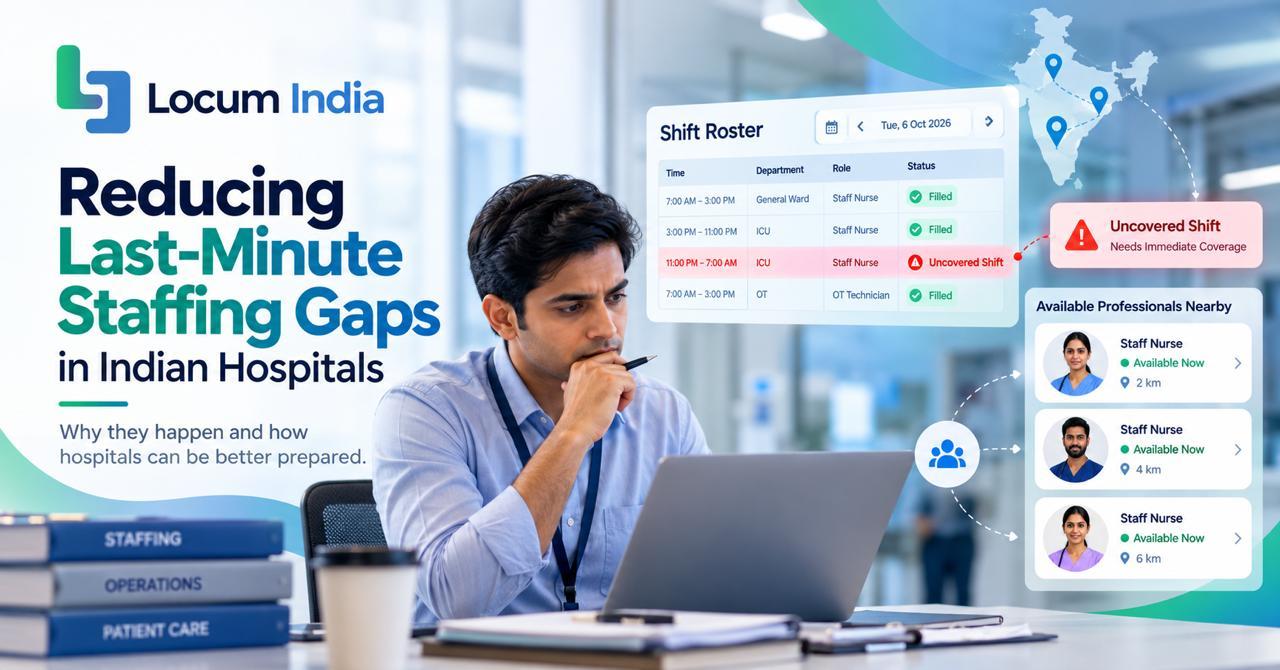
Hospitals operate around the clock, but workforce availability does not always follow a predictable schedule.
A nurse may call in sick before a night shift. A technician may become unavailable unexpectedly. Patient volumes may rise suddenly, or an emergency may create an immediate need for additional clinical support.
When this happens, hospital teams often have only a few hours to arrange coverage.
The challenge is not simply finding another person. It is finding an appropriately qualified professional who is available, suitable for the requirement, and able to report within the required timeframe.
For hospitals, reducing last-minute staffing pressure therefore requires more than reacting quickly. It requires building a system that is prepared before the gap occurs.
Even hospitals with well-planned duty rosters can experience unexpected workforce gaps.
Some common reasons include:
Individually, these situations may appear temporary. Operationally, however, even one uncovered shift can put additional pressure on the rest of the team.
When a staffing requirement appears unexpectedly, the immediate response is often to start calling people.
Hospital administrators may contact existing employees, former colleagues, staffing agencies or professionals within their personal networks. Messages may also be circulated through WhatsApp groups asking whether someone is available.
These methods can sometimes work, but they depend heavily on who happens to be reachable at that moment.
The process may involve multiple phone calls and messages before an available professional is identified.
That creates an important operational question:
Should the search for available professionals begin only after the staffing gap occurs?
A more prepared model is to maintain access to a wider pool of professionals before an urgent requirement arises.
One of the biggest challenges during an urgent staffing requirement is limited visibility.
A suitable healthcare professional may already be available nearby, but the hospital may have no practical way of knowing that.
Better workforce visibility can help hospitals understand:
Instead of starting from zero every time a gap appears, hospitals can move toward a more structured way of identifying potential shift coverage.
Speed becomes important when a shift is only a few hours away.
Hospitals should therefore define what information must be available before an urgent requirement is circulated.
A shift requirement should clearly specify:
Clear requirements reduce unnecessary communication and help suitable professionals decide quickly whether they can accept the shift.
A common response to an uncovered shift is to ask existing employees to stay longer, work overtime or take an additional shift.
Occasional adjustments may be necessary in hospital operations. But repeatedly relying on the same internal team can create additional pressure.
A more resilient staffing approach combines the hospital’s core workforce with access to flexible professionals who can support temporary requirements when needed.
The objective is not to replace permanent employees.
It is to create an additional layer of workforce flexibility around them.
Urgency should not mean ignoring basic verification.
Hospitals still need confidence that the professional reporting for a shift has the relevant identity and professional credentials for the role.
If these checks begin only after someone accepts an urgent shift, they can add further delay.
A better approach is to have verification built into onboarding so that identity and relevant professional credentials are reviewed before professionals become eligible for shifts.
This allows hospitals to focus on matching the requirement with an appropriate available professional rather than beginning the entire verification process from scratch.
Many staffing gaps are ultimately coordination problems.
The requirement exists.
Professionals may be available.
But the two sides do not have an efficient way to discover and coordinate with each other.
Technology can help structure this process by enabling hospitals to post shift requirements and allowing eligible professionals to discover or receive relevant opportunities based on factors such as their role, availability and location.
A structured digital workflow can also support important operational steps such as shift acceptance, attendance confirmation and completion records.
The goal is not simply to digitise a phone call.
It is to reduce the number of manual steps between an uncovered shift and confirmed coverage.
Hospitals should also look beyond individual incidents.
If the same department repeatedly experiences urgent staffing requirements, the problem may not be random.
Tracking patterns can reveal:
This information can help administrators improve workforce planning instead of repeatedly solving the same problem at the last minute.
Hospitals may never eliminate every unexpected staffing gap.
Healthcare is too dynamic for that.
But hospitals can reduce the disruption caused by those gaps by preparing differently.
That means having clear shift requirements, better visibility of available professionals, appropriate verification processes, broader workforce access and systems that allow teams to respond quickly when circumstances change.
The difference is simple:
Reactive staffing starts searching when the gap occurs.
Workforce preparedness builds the ability to respond before the gap occurs.
For a 24×7 healthcare system, that preparedness can make temporary staffing requirements significantly easier to manage.
Healthcare staffing is evolving. Explore how technology, flexible work and on-demand workforce models could shape the future of healthcare staffing in India.
Traditional staffing models may not always match changing hospital needs. Explore how flexible staffing can help manage short-term demand while supporting existing teams.
 Locum
Locum