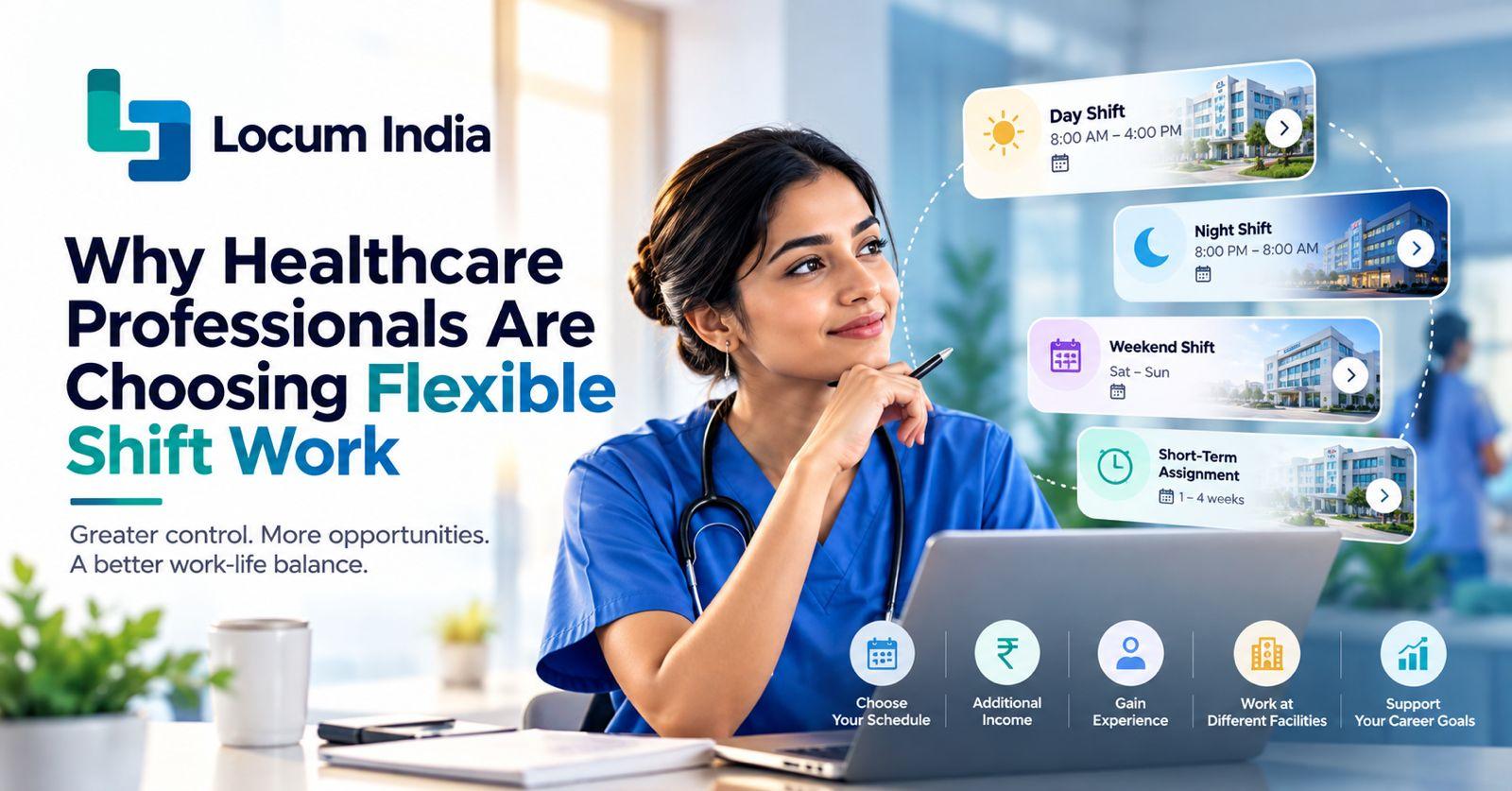
Healthcare careers have traditionally been associated with fixed schedules, permanent roles and structured duty rosters.
But healthcare does not always operate according to a fixed schedule — and neither do the lives and professional goals of healthcare professionals.
Doctors, nurses, clinical assistants, technicians and physiotherapists may sometimes want greater flexibility in when, where and how often they work.
This is where flexible shift work can offer another option.
Rather than replacing permanent employment, flexible healthcare shifts can allow professionals to take additional or temporary assignments based on their availability, qualifications and professional goals.
There is no single reason.
Different healthcare professionals may choose flexible shifts at different stages of their careers and for different circumstances.
For some, flexibility is about earning additional income.
For others, it may be about gaining experience, using available time productively or maintaining professional engagement without committing to another permanent role.
Here are some of the practical reasons healthcare professionals may consider flexible shift work.
One of the most obvious advantages of flexible shift work is greater choice over availability.
Instead of committing to another fixed employment schedule, professionals may be able to consider individual opportunities based on:
A healthcare professional who is unavailable during weekdays, for example, may prefer weekend opportunities.
Someone with free time between existing professional commitments may prefer shorter assignments.
The important difference is that the professional can evaluate each opportunity individually rather than committing to a continuous work schedule.
Additional income can be another reason professionals explore locum or flexible shifts.
Healthcare professionals may have periods when they are available beyond their regular commitments and want to use that time productively.
A temporary shift can provide an additional earning opportunity without necessarily requiring a change in permanent employment.
However, compensation should never be the only factor considered.
Before accepting a shift, professionals should also understand the responsibilities, working hours, location, clinical environment and qualification requirements.
A higher shift rate does not automatically make an opportunity appropriate.
Not every healthcare professional has the same working pattern.
Some may have rotating schedules.
Others may work part-time, have gaps between assignments or have certain days available during the month.
Flexible shifts can provide a way to use those available periods professionally.
For example, a professional may choose to consider:
The key is that any additional work should fit responsibly around existing commitments, adequate rest and applicable workplace policies.
Working in different healthcare facilities can expose professionals to different teams, workflows and clinical environments.
Hospitals can vary considerably in:
Appropriate exposure to different environments may help professionals broaden their understanding of how healthcare teams operate.
However, professionals should accept only those assignments that match their qualifications, competence and permitted scope of practice.
Flexible work should never mean taking responsibilities for which someone is not appropriately prepared.
Healthcare professionals may need different types of work arrangements at different stages of their careers.
A professional’s availability and priorities can change over time.
Flexible shifts may be relevant for professionals who are:
This does not mean flexible work is appropriate for everyone.
It simply creates another possible way of participating in the healthcare workforce.
Location is an important part of any healthcare shift.
A professional may be willing to travel a short distance for a temporary assignment but may not want a long daily commute associated with another permanent role.
Flexible staffing can allow professionals to evaluate opportunities individually based on distance and travel time.
Before accepting, consider:
A shift should make practical sense after travel requirements are considered.
Flexible work does not mean accepting every available shift.
In fact, the ability to say no is an important part of choosing shifts responsibly.
A professional should evaluate whether an opportunity matches:
Qualification + Experience + Skills + Availability + Location
If the answer is no, declining the shift may be the right decision.
The objective should be to find appropriate professional opportunities — not simply the maximum number of shifts.
Flexible healthcare shifts may be relevant to different professionals depending on their circumstances.
These could include:
Individual eligibility will depend on the requirements of the healthcare facility, the professional’s qualifications and the responsibilities involved.
Flexible work should always remain within the professional’s competence and applicable professional requirements.
Flexibility has advantages, but it also comes with responsibilities.
Unlike a permanent role, temporary shift opportunities may not provide predictable or continuous work.
Professionals may also need to evaluate new facilities, teams, reporting structures and working environments more frequently.
Before accepting a flexible shift, understand:
Clarity before accepting the assignment can reduce misunderstandings later.
Flexibility should never come at the cost of patient safety or professional responsibility.
Healthcare professionals should not accept assignments that fall outside their qualifications, registration, competence or permitted scope of practice.
They should also consider whether additional shifts could create excessive working hours or inadequate rest.
The question should not simply be:
Can I take this shift?
It should also be:
Am I appropriately qualified, prepared and available to perform this shift responsibly?
When healthcare professionals move between temporary assignments, verification becomes particularly important.
Healthcare facilities need confidence that professionals entering their clinical environment have appropriate identity and professional credentials.
Professionals also need clear information about the healthcare facility and the assignment they are considering.
A structured flexible staffing system should therefore provide greater visibility on both sides.
For professionals, keeping identity documents, qualifications and relevant professional credentials updated can help make the process more efficient.
Locum India is building a technology-enabled healthcare shift-staffing platform designed to connect healthcare facilities with verified healthcare professionals for temporary and shift-based requirements.
Instead of depending entirely on phone calls, personal networks and fragmented messaging groups, the platform is being designed around a more structured workflow.
Healthcare facilities can post shift requirements, while eligible professionals can discover opportunities that match their professional profile and availability.
The planned workflow includes:
Post Requirement → Match → Accept → OTP Check-in → Complete Shift
Verification is built into onboarding, with identity and relevant professional credentials reviewed before professionals become eligible for shifts.
Locum India is focused specifically on healthcare shift staffing rather than permanent-job recruitment.
That depends on your individual circumstances.
Flexible work may be useful if you want greater control over when you take additional professional assignments.
But every opportunity should still be evaluated carefully.
Before accepting a shift, ask yourself:
If those questions have clear answers, you can make a more informed decision.
Flexible healthcare work does not have to replace permanent employment.
For many professionals, the two models can serve different purposes.
Permanent roles can provide continuity and structured employment.
Flexible shifts can provide additional choice when professionals have suitable availability.
The opportunity is to make flexible healthcare staffing more organised, transparent and professionally appropriate.
For healthcare professionals, that means being able to evaluate the right shift at the right time — based on their skills, availability and professional responsibilities.
Healthcare staffing is evolving. Explore how technology, flexible work and on-demand workforce models could shape the future of healthcare staffing in India.
Traditional staffing models may not always match changing hospital needs. Explore how flexible staffing can help manage short-term demand while supporting existing teams.
 Locum
Locum