Hospitals are built around people, processes and infrastructure working together around the clock.
A hospital may have beds, operating theatres, diagnostic equipment and clinical systems ready, but every part of that infrastructure ultimately depends on having the right healthcare professionals available at the right time.
When staffing falls below what a department or shift requires, the impact is rarely limited to an empty position on the duty roster.
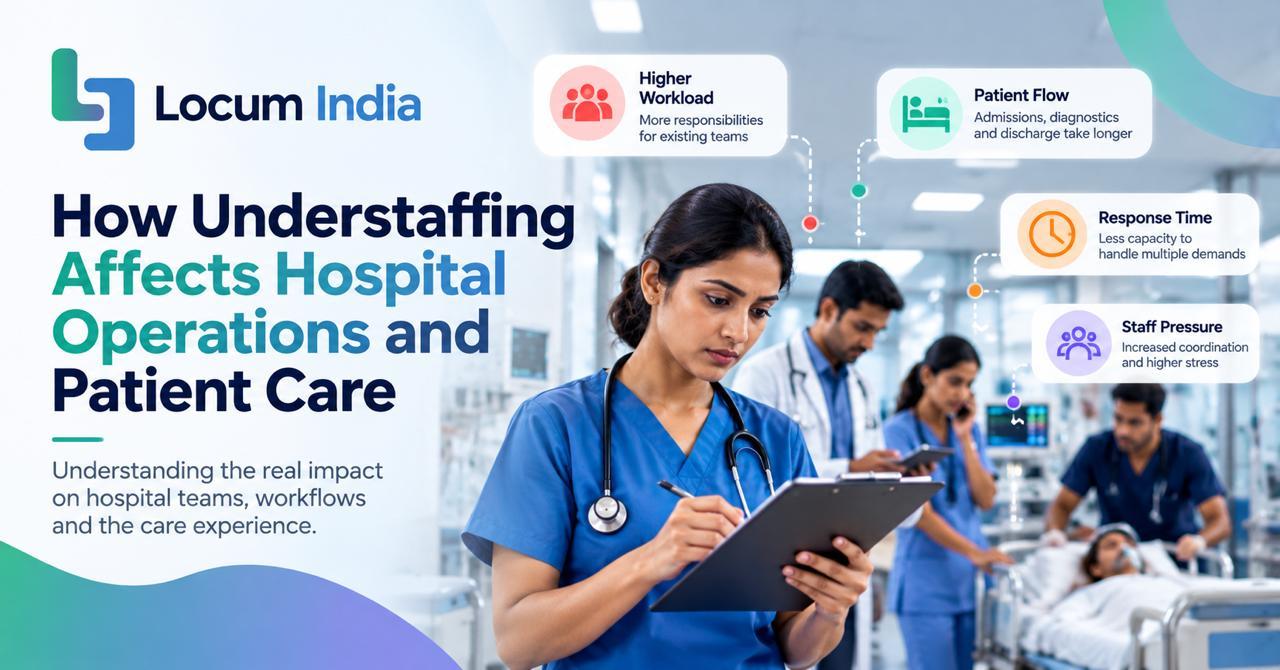
The effects can move across the hospital — increasing pressure on existing teams, affecting patient flow, slowing operational processes and making it more difficult to maintain a consistent care experience.
Understanding these operational effects is important because understaffing is not simply a recruitment problem.
It is a workforce management challenge.
Understaffing occurs when the available workforce is insufficient for the workload or operational requirements of a particular shift, department or period.
It does not always mean that a hospital has a permanent shortage of employees.
A hospital may have an appropriate overall workforce and still experience temporary understaffing because of:
This distinction matters.
Sometimes the challenge is not the total number of professionals employed by the hospital. It is having the required professionals available at the particular place and time they are needed.
One of the most immediate effects of an understaffed shift is that the existing team may need to absorb additional responsibilities.
A smaller number of professionals may have to manage the workload that would normally be distributed across a larger team.
This can mean:
Occasional adjustments are part of hospital operations.
The concern arises when additional workload becomes frequent rather than exceptional.
A workforce model that repeatedly depends on existing employees absorbing staffing gaps can place sustained operational pressure on the team.
Hospital operations depend heavily on movement.
Patients move from registration to consultation, from emergency to diagnostics, from operating theatres to recovery areas and from inpatient beds to discharge.
Healthcare professionals support every stage of that movement.
When staffing is constrained in one area, the effects can extend beyond that department.
For example, limited workforce availability may make it more difficult to:
This is why staffing should not be viewed only at the individual department level.
A workforce gap in one part of the hospital can influence processes elsewhere.
Hospitals manage many activities simultaneously.
Patient requests, clinical coordination, investigations, documentation, medication processes, procedures and operational communication may all be happening at the same time.
When fewer professionals are available to manage those responsibilities, teams may have less capacity to respond to multiple demands simultaneously.
Not every delay is caused by staffing, and staffing levels alone do not determine hospital performance.
However, adequate workforce availability gives teams greater capacity to distribute responsibilities and respond when workload changes unexpectedly.
Understaffing does not affect only frontline clinical work.
It can also increase the coordination burden on hospital administrators, nursing supervisors, department heads and operations teams.
When someone becomes unavailable, managers may need to:
These activities consume management time that could otherwise be used for planned operational priorities.
When staffing gaps happen repeatedly, workforce coordination itself can become a significant operational workload.
Overtime and additional shifts can provide valuable flexibility when hospitals face temporary staffing requirements.
There will always be situations where existing employees voluntarily extending a shift or accepting additional duty is the fastest practical solution.
But overtime has limitations.
The same professionals may not always be available, and repeatedly depending on a small group of employees does not create a broader backup workforce.
Hospitals therefore need multiple options for responding to temporary demand rather than relying on one method every time a gap appears.
Patients rarely see the workforce planning happening behind the scenes.
They experience the result of the system.
Their hospital journey may involve doctors, nurses, technicians, pharmacists, physiotherapists, support teams and administrative staff.
When the workforce is appropriately aligned with operational demand, these different parts of the hospital can coordinate more effectively.
When teams are under pressure, maintaining the same level of coordination can become more difficult.
This is why workforce planning contributes to patient experience even when patients never directly see the staffing process itself.
Understaffing should not be treated as a single hospital-wide number.
Different departments have different workforce requirements.
An uncovered staff nurse shift in an inpatient unit creates a different operational challenge from an unavailable OT technician before a procedure or a radiology technician during a busy diagnostic period.
Hospitals therefore need visibility at the level of:
This helps administrators understand where staffing pressure actually exists rather than relying only on overall headcount.
Not every staffing requirement requires permanent recruitment.
If a hospital regularly needs another full-time professional, recruitment may be the appropriate solution.
But some requirements are genuinely temporary.
For example:
Using permanent recruitment as the only workforce solution does not necessarily address these short-duration requirements efficiently.
Hospitals also need access to flexible staffing options that can complement their permanent workforce when temporary demand arises.
A common challenge during temporary understaffing is not necessarily the absence of available professionals.
It is the hospital’s limited visibility of who may be available.
Suitable healthcare professionals may exist within the same city, but hospitals may have no structured way to identify their availability at the required time.
Improving workforce visibility can help hospitals understand:
This can reduce dependence on starting a manual search from the beginning every time a temporary requirement appears.
Healthcare workforce technology can help create a more structured connection between temporary hospital requirements and professionals looking for flexible shift opportunities.
Instead of relying entirely on phone calls, messaging groups and personal networks, hospitals can post specific shift requirements containing information such as:
Eligible professionals can then identify opportunities relevant to their role and availability.
Technology does not replace workforce planning.
It can provide hospitals with another operational tool for managing the variability that already exists within healthcare staffing.
The more useful workforce question for hospitals is not simply:
“How many people do we employ?”
It is also:
“Do we have the right professionals available for the workload we expect during this shift?”
That shift in perspective changes workforce planning from a static headcount exercise into a more dynamic operational process.
Hospitals will always need strong permanent teams.
But healthcare demand changes by department, shift and day — sometimes unexpectedly.
Building greater visibility, preparedness and flexibility around the permanent workforce can help hospitals respond to those changes more effectively.
Ultimately, managing understaffing is not only about filling an empty position.
It is about ensuring that the workforce and the hospital’s operational requirements remain aligned when demand changes.
Healthcare staffing is evolving. Explore how technology, flexible work and on-demand workforce models could shape the future of healthcare staffing in India.
Traditional staffing models may not always match changing hospital needs. Explore how flexible staffing can help manage short-term demand while supporting existing teams.
 Locum
Locum